How Tech Founders and Operators Really Found Product-Market Fit
What 140+ tech founders and operators trust as proof, what they ignore, and how to tell the difference before it costs you a year.

tl;dr: 140+ leaders described what product-market fit actually looked like when it arrived. The signals were behavioral, not numerical. The original target was almost never the real customer. Most founders spent months chasing engagement that looked like love but behaved like indifference.
Stop guessing whether your dashboards are telling you the truth. Databox is an AI-powered analytics platform that pulls performance data from 130+ tools into one place, so the signals that actually predict retention stop hiding in tabs you forgot to open.
Ask Genie AI a plain-English question like “why did engagement drop last week” and get a clear answer back, with a chart, grounded in your real numbers. More than 20,000 growing businesses and agencies already run on it. Start a free trial here.
The founder’s phone rings at 9 p.m. on a Tuesday.
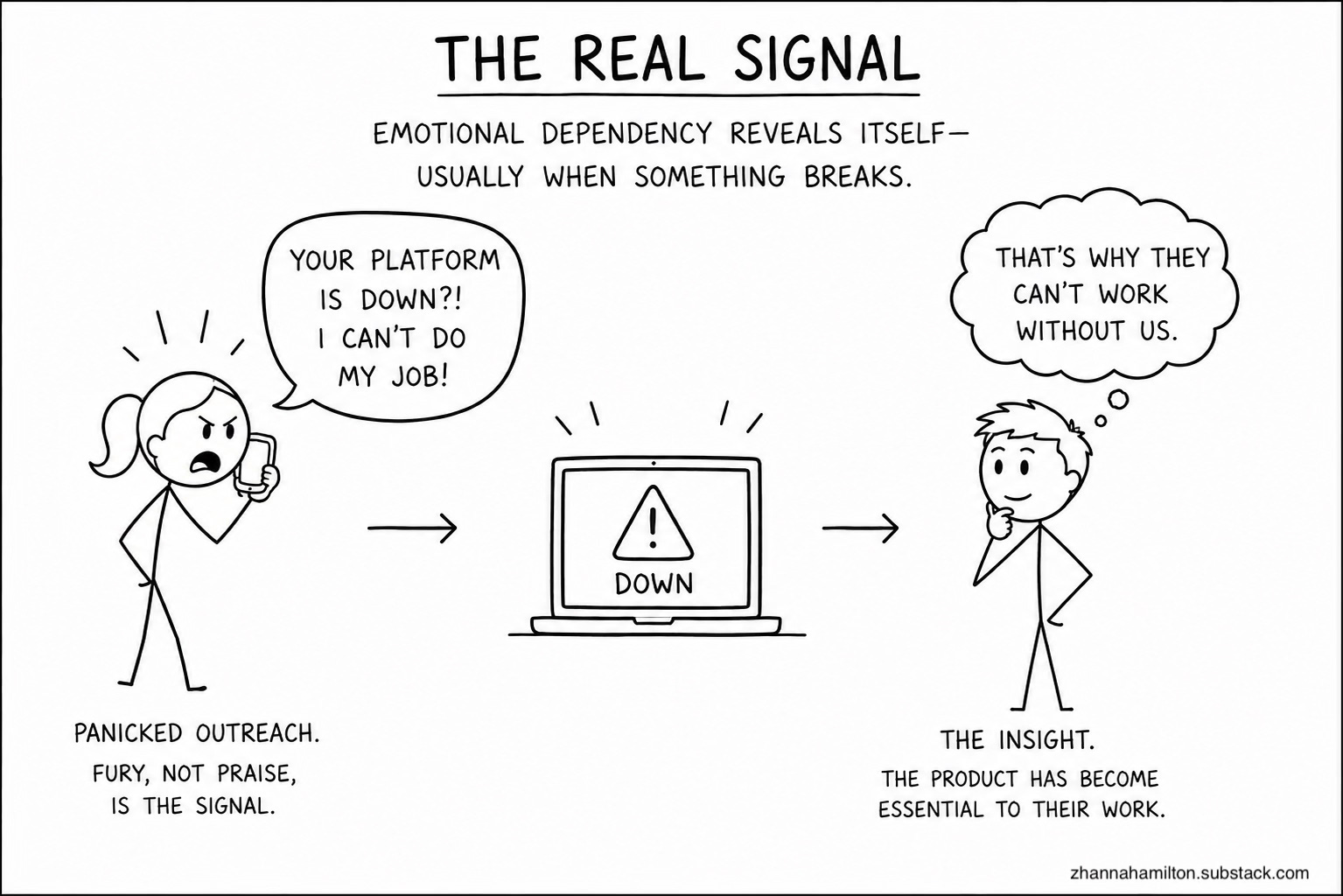
It is a customer she has been working with for four months. The woman on the other end of the line is furious. The platform is down for maintenance.
The customer has been trying to find a replacement third-party logistics provider for three hours, and she cannot do her job without it.
That is the moment the founder knows. The fury, not the praise, is the signal.
I asked a wide group of tech founders, CEOs, operators, and advisors how they actually determined product-market fit. Not the textbook version. The signals they trusted, the ones they misread, and what they would do differently now.
More than 140 leaders weighed in.
What follows is the synthesis of those responses, paired with the formal research that confirms what they were privately figuring out on their own.
Isaac Asimov’s novel Foundation gave us a useful frame for this. In it, Hari Seldon is a mathematician who develops a science for predicting the future of civilizations. He could not predict what any single person would do. He could only read the patterns that thousands of people created together.
Once you knew how to read them, those patterns told you almost everything.
Product-market fit works the same way. No single customer tells you whether you have it. The pattern across many of them does.
By the Numbers
A few aggregate signals worth surfacing before we go further.
Of the 140+ leaders who weighed in, the majority described their first credible PMF signal as a behavior rather than a metric. Unprompted referrals, workflow integration, panicked outreach during downtime, or customers asking how to do more with the product rather than what it does.
A meaningful share of them, somewhere north of 60, said their original target customer was not their actual customer. The shift usually became obvious within three to six months. They spent additional months ignoring it.
Nearly every founder named the same misread. High engagement that looked like love but behaved like indifference. Customers who logged in daily, generated support tickets, and renewed without enthusiasm, while privately shopping for a replacement.
The pattern is consistent enough that it is worth treating as a working model.
The Signal Hiding in Plain Sight
The strongest signal almost no one called out in advance was emotional dependency.
Customers do not announce that your product has become essential to them. They reveal it by accident, usually when something breaks.
Joe Spisak, Founder and CEO of Fulfill.com, a digital marketplace connecting eCommerce brands with vetted third-party logistics providers, described the moment he stopped wondering whether he had fit. He is a four-time founder with two successful exits, including a 140,000 square foot fulfillment warehouse he built and sold.
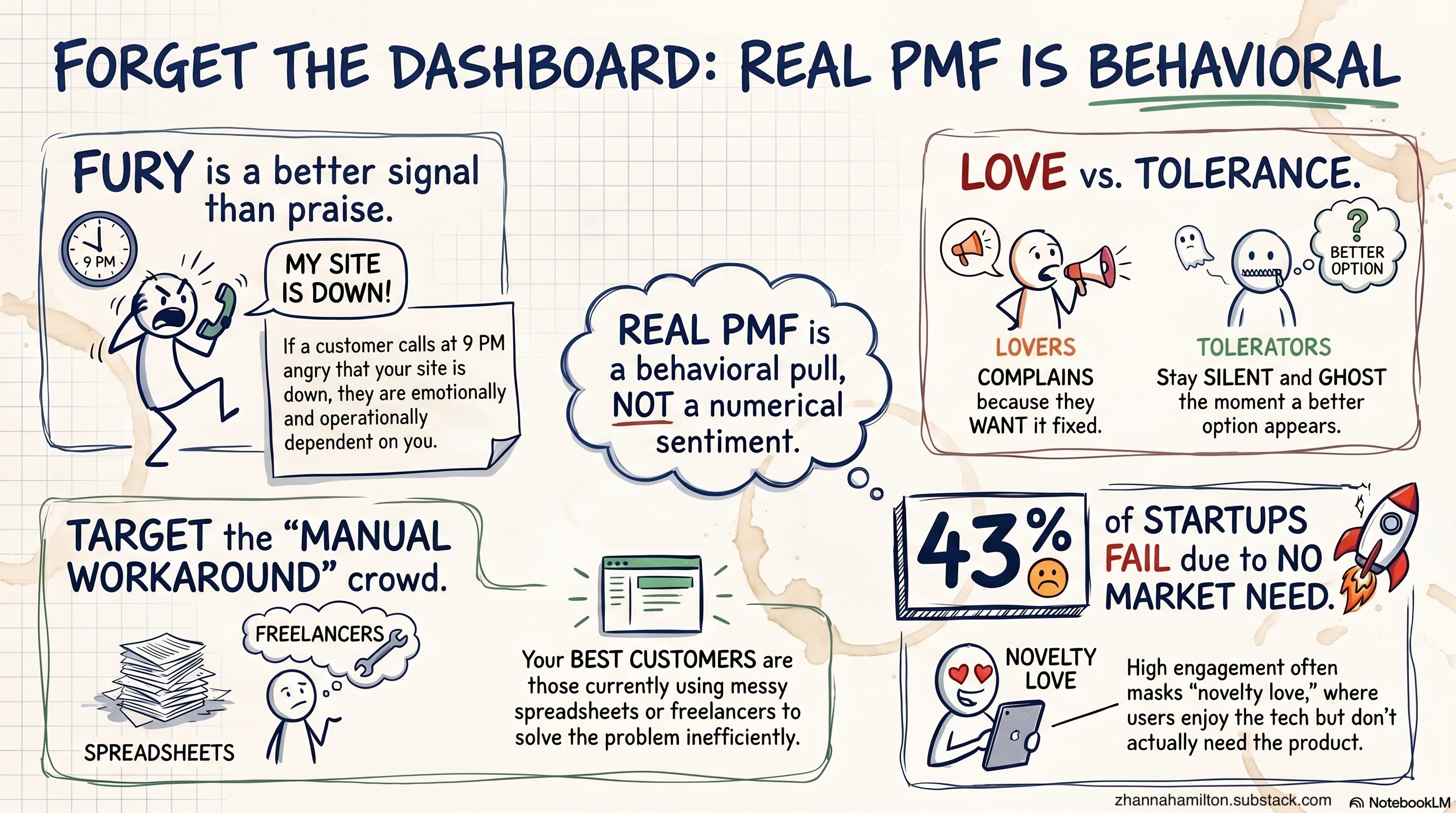
“I thought I had product-market fit with Fulfill.com when our first 50 brands signed up in month one. Wrong. They signed up because the idea sounded useful, not because they desperately needed it. The real signal came four months later when a brand called me at 9 PM furious that our platform was down for maintenance. She’d been trying to find a new 3PL for three hours and couldn’t work without us. That’s when I knew.”
Andrew Yan, Co-Founder and CEO of AthenaHQ, framed the same idea in calmer terms. AthenaHQ is a Y Combinator W25 company helping brands appear in AI-generated answers across ChatGPT, Perplexity, Claude, and Gemini. It is backed by angels from DeepMind, Anthropic, and OpenAI and works with brands like Coinbase, SoFi, and Twilio.
“We knew we had it when customers started using the tool for new reasons and renewed without asking for a discount. I used to think beta feedback was enough, but that didn’t mean much. It only clicked when they built their daily work around us. That reliance, not just the excitement, was what actually mattered.”
Andrei Blaj, Co-Founder of Medicai, a medical imaging platform, watched the same shift inside enterprise accounts.
“We realized product-market fit was real when customers stopped treating us like we were testing an idea and started treating the product as part of their operations.”
He continued.
“The first signal was usually not a dashboard metric. It was behavior. Customers came back with sharper questions, involved more stakeholders, and began discussing rollout, integration, and continuity rather than just features. That told us the product was moving from interest to dependency.”
The 9 p.m. phone call. The unprompted “how do I do more with this.” The shift from “what does this do” to “can it also handle this.” Different industries, identical behavior.
My Takeaway: The most valuable PMF signal is the one customers do not realize they are sending.
When a person bends their workflow around your product without being asked, when they get angry that maintenance windows interrupt them, when they invite three coworkers into the account before you have a referral program – they are telling you something their satisfaction survey cannot.
In a world where AI is making it cheap to ship plausible-looking products quickly, the leaders who win will be the ones who learn to read silence and fury rather than smiles and stars.
The False Positives That Cost the Most Time
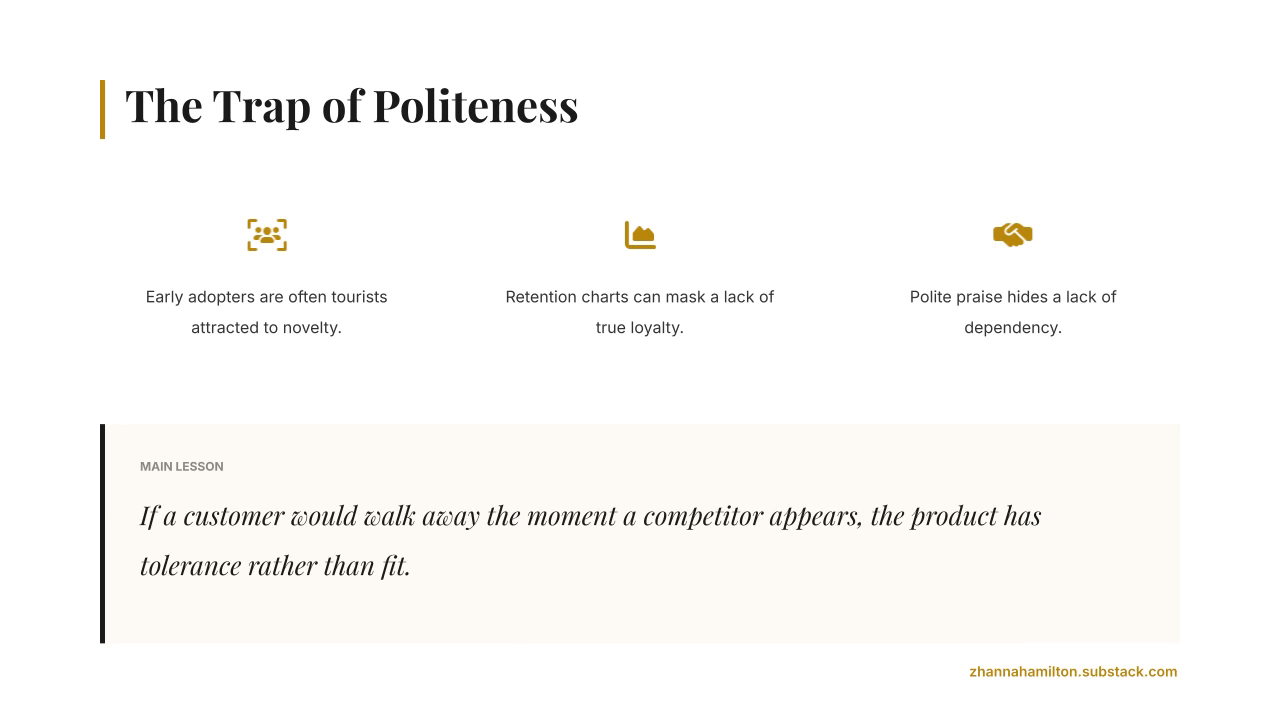
Almost every founder named the same trap. Polite enthusiasm is not the same as need.
People will tell you they love your product because they are kind, or curious, or supportive. They will book a demo and send a thank-you email and never come back. The data looks healthy. The relationship is hollow.
Andrew Gazdecki, Founder and CEO of Acquire.com, put it bluntly. Acquire.com is the largest marketplace for buying and selling SaaS startups. The company made the Inc. 5000 in 2025 at #563 with more than 2,000 acquisitions and $500M+ in closed deal volume.
“I felt we had it when the customers began using the product in ways I didn’t expect and recommending it to friends without being prompted. At my last startup I mistakened feature requests for evidence of demand and was addressing the wrong market for six months until I worked out our true fans didn’t actually operate in our industry. Seems people really are just nice when they have no use for you.”
Six months. That is the cost of misreading politeness as fit.
Runbo Li, Co-Founder and CEO of Magic Hour, hit a more specific version of the trap. Magic Hour is a Y Combinator W24 AI video platform serving more than 2.5 million creators. He thought his early adopters were his core audience. They were tourists.
“Early on, we saw tons of engagement from AI hobbyists, people who loved experimenting with models and pushing the tech. I thought that was our core. It wasn’t. Those users churned the moment a new open-source model dropped because they were loyal to the novelty, not the product.”
The behavior looked like product love. It was novelty love wearing a product-love costume.
This pattern is going to get worse, not better, as AI tools multiply. A meaningful share of every new AI product’s early traffic is going to be other founders, tinkerers, and curious technologists. Treating their behavior as evidence of fit is the modern version of confusing demo praise with customer commitment.
Niclas Schlopsna, Managing Partner at Spectup, a startup advisory firm, sees this misread happen at scale across his client base.
“What I’ve watched founders misread most often is active users who don’t churn but also don’t expand. That looks like retention on a chart and behaves like indifference in a room. Love shows up as volunteered referrals, angry emails when something breaks, and customers who adjust their own workflows around your product. Tolerance looks like flat usage and renewal conversations that feel transactional.”
Retention on a chart that behaves like indifference in a room. That is the language to internalize when you look at your own dashboards next.
The shape of the data does not always match the shape of the relationship.
My Takeaway: The instinct to interpret every positive signal as proof of fit is something founders have to actively fight.
Engagement, kind words, even paid usage can all coexist with a market that does not actually need you. The cleanest test is to ask what happens when you remove the friction of staying.
If a customer would walk the moment something easier appeared, you have tolerance. If they would chase you down the moment something broke, you have love. The discipline is to be honest about which one you have, even when the chart looks the same.
What the Outside Research Says
These leaders were not working in a vacuum. The published research on why startups fail and how PMF gets measured tells a parallel story.
Marc Andreessen first put the phrase “product-market fit” into circulation in a widely circulated 2007 essay. He argued that the single thing that matters for an early company is being in a good market with a product the market actually wants. His framing has held up across two decades because it points to the same thing the founders above kept pointing to: traction is not a feeling, it is a measurable pull.
CB Insights gave that pull a number. In its original analysis of failed startup post-mortems published in 2014, the firm reported that 42% of failures traced back to “no market need.” An updated 2024 analysis of 431 venture-backed shutdowns refined the figure to 43% for poor product-market fit specifically, with cash exhaustion appearing as the visible end state in 70% of cases.
The reframe matters. Running out of money is the symptom that gets written on the gravestone. The underlying cause is almost always that not enough people wanted the thing badly enough to keep paying.
Sean Ellis, the marketer who helped scale Dropbox, LogMeIn, and Eventbrite, developed the question that most operators now reach for first. His test asks active users a single question: how would you feel if you could no longer use this product. If 40% or more answer “very disappointed,” the product has reached fit. Below that threshold, it has not.
The wording was deliberate. Ellis wanted to measure dependency rather than approval, because approval inflates and dependency does not.
The Sean Ellis test got famous in part through Rahul Vohra, founder and CEO of Superhuman, a premium email app used by founders and executives. Vohra wrote a widely shared 2018 piece for First Round Review explaining how his team took their PMF score from 22% to 58% by segmenting users and reorganizing their roadmap around the dependency signal. It is essentially a quantitative version of what the founders above were learning from 9 p.m. phone calls.
The last research thread comes from customer advocacy. Bain & Company developed the Net Promoter Score, which measures how likely a customer is to recommend your product to a colleague and uses that signal as a predictor of growth. Bain has published years of findings showing that businesses with strong advocacy scores tend to outgrow comparable competitors at multiples that hold up across industries.
The behavior driving those numbers is the same behavior the founders kept describing. Customers refer peers without prompting, defend the product in internal meetings, and expand spend without negotiation.
Different decades, different methodologies, same conclusion. Real fit is behavioral.
The frameworks just give names and numbers to what practitioners have always observed in the field.
Running performance reports across dozens of clients? Databox was built for exactly that. White-labeled client dashboards and scheduled reports that send themselves on the cadence you set, so your team stops losing hours to status update emails on Mondays.
Stop stitching together screenshots from GA4, HubSpot, and Facebook Ads. Try Databox free here.
Your Original Customer Probably Isn’t Your Real Customer
The next pattern is the one most founders see coming and still get wrong.
The customer you thought you were building for is usually adjacent to the customer who actually pays, stays, and refers. The shift becomes visible in usage data three to six months in. Then it takes another stretch of months to actually move marketing, onboarding, and positioning to match.
Spisak from Fulfill ran headfirst into this. He described the pivot in unusually concrete terms.
“My original target was small DTC brands doing under $1M. Turns out my best customers were doing $3M to $15M annually. They had enough volume to care deeply about 3PL performance but not enough to have a full logistics team. The sub-$1M brands liked us but didn’t convert because they were still in survival mode, not optimization mode. Took me almost a year to realize I was marketing to the wrong revenue band.”
He noticed a second pattern under the first one.
“My best early customers all had one thing in common I missed for months. They’d all been burned by a 3PL before. They weren’t looking for their first provider, they were looking for their second or third.”
That detail changed the entire positioning of the company. The pitch shifted from “find a logistics partner” to “find the right one this time.” Same product. Completely different sales conversation.
Riken Shah, Founder and CEO of OSP Labs, a healthcare IT company, pointed to a pattern I would argue is the single most important predictor of real fit in this entire collection of founder experiences.
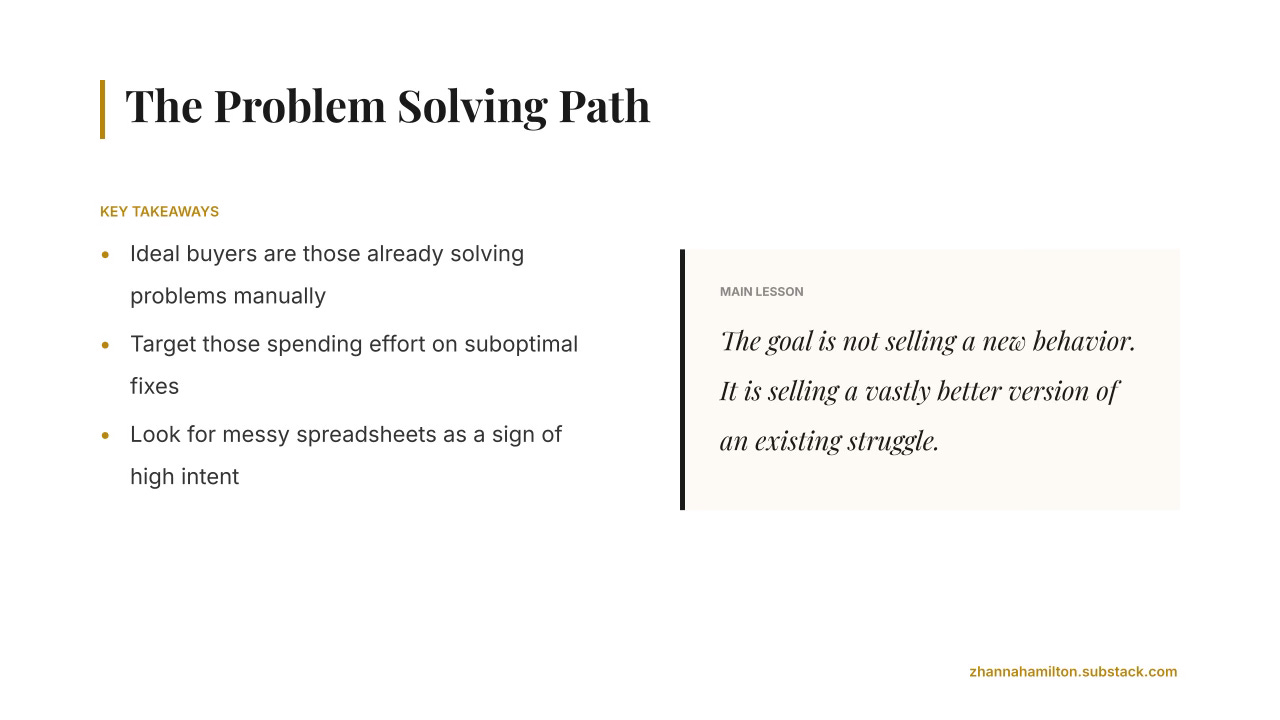
“Looking back, our best early customers all had one thing in common: they were already solving the problem manually or inefficiently. We didn’t create the need to fit into something that already existed.”
That is a load-bearing sentence.
The customers most likely to love your product are the ones already doing the work in a worse, slower, more painful way. They have a manual workaround, an ugly spreadsheet, a freelancer, or a person on their team whose job is to clean up the gap.
You are not selling them a new behavior. You are selling them a better version of a behavior they have already committed to.
The outlier here is worth dwelling on, because it inverts the conventional wisdom about enterprise sales. Victor Smushkevich, Founder of Call Setter AI, expected his best customers to be large companies. They were not.
“Early on, I misread enterprise interest as product market fit. Large companies took meetings, ran pilots, then ghosted because their procurement cycles outlasted our runway. The real customers turned out to be owner operators in HVAC, dental, and insurance who lost leads every night after 5pm and needed the problem solved by Friday, not next quarter.”
The lesson he drew is one most founders would benefit from internalizing early.
“Customers who tolerate you ask for discounts; customers who love you ask for integrations. My longest wrong assumption was that bigger logos meant better fit, when speed of deployment was the actual filter all along.”
Speed of deployment as the real filter. For most early-stage tech products, that is a more useful thing to sort by than industry, company size, or revenue band.
My Takeaway: The cleanest way to find your real customer is to look at who already has the problem and is doing something inelegant about it.
Forget the persona deck. Look at the people who have a manual workaround they hate. They are pre-qualified. They have admitted, in their own behavior, that the problem matters enough to spend effort on.
A useful exercise: ask your last twenty customers what they were doing before they found you. If most of them say “nothing,” you are educating the market, which is slow and expensive. If most of them name a spreadsheet, a freelancer, or a competing tool they were unhappy with, you have found the seam.
Love Versus Tolerance: How to Tell the Difference
This is the heart of the founder experiences gathered here. It is also where the most founders waste the most time.
Tolerated products and loved products look almost identical from a dashboard. The same usage numbers, the same renewal rates, sometimes the same NPS scores. The difference shows up in behavior, especially when things go wrong.
Isabella Rossi, CPO at Fruzo, a video-first social platform, described one of the cleanest versions of the distinction.
“When users started getting genuinely upset about downtime rather than just working around it, that was the clearest signal. Dependence that generates frustration is different from interest that generates excitement.”
Dependence that generates frustration. That is the language to look for in support tickets.
Ben Read, Co-Founder and CEO of Mercha, framed the test even more sharply. Mercha is a bootstrapped B2B branded merchandise platform that grew 130%+ year-on-year and landed enterprise customers like Samsung without chasing them.
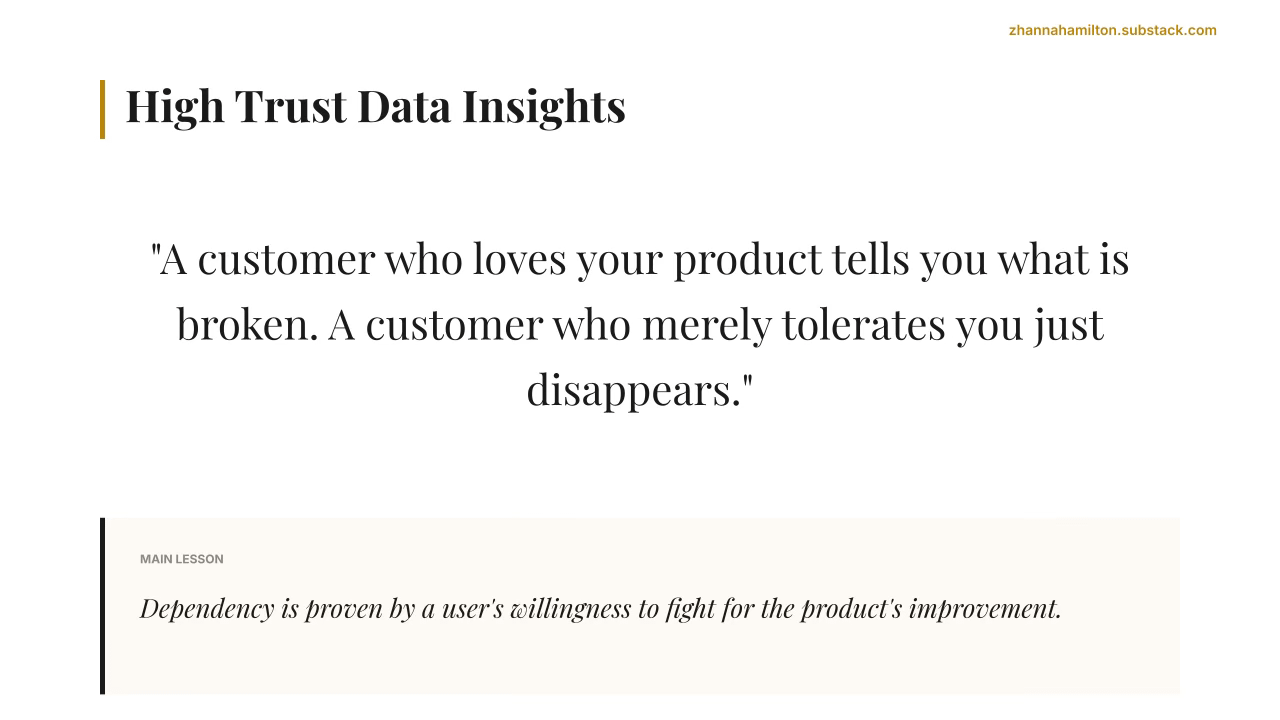
On distinguishing love from tolerance, Read said it this way: “a customer who loves your product tells you what’s broken because they want it fixed. A customer who merely tolerates you just disappears.”
He told a story that crystallized the point. An early customer in Melbourne had a bad experience and almost churned. She did Read the favor of telling him directly.
In his words: “That feedback was worth more than a hundred positive reviews.”
The Melbourne customer ended up sending Read’s team flowers after they called her, fixed the issues, and convinced her to reorder. She is still a customer. That, Read said, is the difference.
Tolerators ghost. Lovers complain.
The complaint, when it comes from a customer who needs you, is one of the highest-trust gifts you will ever receive. It means they care enough about the relationship to fight for it.
Li from Magic Hour has a sharper diagnostic for separating the two groups in everyday feedback.
“Customers who love your product tell other people about it without incentive. Customers who tolerate it submit feature requests that are really complaints in disguise. They’ll say ‘it would be great if you could do X,’ and what they mean is ‘I’m using you because I have no other option, but the second someone builds X, I’m gone.’ We track sharing behavior more closely than satisfaction surveys for exactly this reason.”
Most feature requests are complaints. Some of them are love letters.
Knowing the difference changes what you build next.
My Takeaway: The most useful question to ask about every customer in your CRM is not “are they happy” but “would they fight for us if something broke.”
If the answer is yes, you have a relationship that can survive a bad quarter, a price increase, or a competitor’s launch. If the answer is no, you have a renewal that will disappear the moment switching gets easier.
This distinction matters more as AI lowers the cost of building competing products. The companies that win the next decade will be the ones whose customers cannot imagine using anything else, and would tell you so before slipping away to whatever launches next.
The Assumption That Took Longest to Unlearn
The last pattern is about the belief each founder held longest before reality forced them to update.
These are the assumptions that survive past the point where they should have died. They feel intuitively correct, and the data needed to disprove them takes time to accumulate.
Einar Vollset, Managing Partner at Discretion Capital, has watched this play out across hundreds of acquisitions. Discretion Capital is a sell-side M&A advisory firm for B2B SaaS companies in the $2M to $25M ARR range. Vollset is a former Cornell CS professor who co-founded a YC-backed startup that sold to Google.
“My longest-held wrong assumption was believing a product’s core feature set, once built, would sustain growth indefinitely, overlooking that all growth decays without continuous, market-aligned innovation.”
That decay function is the hidden tax on every tech company. The market moves. Customer expectations move.
The product that fit perfectly in 2024 starts to feel adequate in 2025 and inadequate in 2026, even if nothing about it has changed.
Syeda Sultana, Chief Operating Officer of Vettted, described an assumption that runs against the standard “build a great product and it will sell itself” gospel.
“My longest-lasting assumption that proved to be incorrect is the idea that quality would be self-selling. It does not. Quality reduces churn. It is the clarity of positioning that sells.”
Quality reduces churn. Clarity sells.
Those two functions are different jobs. Both matter. Most early-stage founders over-invest in one and under-invest in the other, and which one depends on the founder’s background.
Technical founders tend to build great products that no one understands. Marketing founders tend to position brilliantly around products that cannot sustain the promise.
Jamie Gyolai, Vice President at Lean Technologies, described an assumption that catches almost every B2B founder eventually. Lean Technologies operates Thrive, a shop floor management platform running at manufacturers like ASSA ABLOY and Sargent Manufacturing.
“The assumption I held longest that turned out wrong: that companies needed to use most of Thrive to justify buying it. The reality is our best early customers cost-justified the entire platform with one module, then grew into the rest naturally.”
One module first. Then expansion.
This is the pattern that drives Net Revenue Retention, the metric Vollset called out earlier as one of the cleanest financial signals of real PMF. Customers do not adopt the full suite on day one. They adopt the piece that solves their most painful problem, prove the ROI, and then expand because trust is now in place.
If you sell the full platform, you lose the deal. If you sell the wedge, you earn the right to sell the rest later.
My Takeaway: The assumptions that hurt the most are the ones that sound like wisdom.
“Build a great product and it will sell.” “More features means more retention.” “Bigger logos mean better customers.” Each of these has just enough truth in it to feel like a principle, and each one quietly causes founders to invest in the wrong direction for months at a time.
The discipline that separates founders who find fit from founders who never do is the willingness to actually examine the assumption when usage data starts to disagree with it. Not to defend the strategy. Not to find a clever reframe. To update.
How to Read PMF Signals Without Fooling Yourself
If you want to translate everything above into a working practice, here is the field guide drawn from across the founder experiences. None of these are dashboard metrics. All of them are observable behaviors you can start tracking this week.
Listen for the language gap. When strangers describe your product back to you using words you never put in your marketing, you are seeing real fit form. Track which phrases keep appearing in customer conversations that did not come from you, and let those phrases shape your next round of messaging.
Watch what happens during downtime. A maintenance window is a free PMF survey. The customers who get angry are the ones who depend on you, and the ones who shrug are the ones who would leave for a slightly better option.
Measure unprompted outreach. Track the rate at which customers contact you without being prompted, especially with referrals, integration requests, and “can it also handle this” questions. A rising rate is one of the cleanest leading indicators of fit you have access to.
Audit who already had the problem. Ask your last twenty customers what they were doing before they found you. If they name a spreadsheet, a freelancer, or a competing tool, you have found a hot lane. If they say “nothing,” you are educating a cold market and that is a much harder business to build.
Translate feature requests. Treat every “it would be great if you could do X” as a question, not a roadmap suggestion. Customers who love the product use feature requests to expand it, while customers who tolerate it use them as a quiet exit interview.
Watch for self-justifying wedges. The most reliable expansion pattern in this data was a customer cost-justifying the whole platform on one module, then growing into the rest. If a single feature can pay for itself, the rest of the product becomes upside instead of obligation.
Track the small ask-for-more behaviors. People asking how to pay more, requesting custom integrations, inviting coworkers without a referral program, or asking for deeper account controls are all early dependency signals. None of them show up cleanly on a default dashboard, which is part of why they are valuable.
The throughline across every one of these is the same. Real fit shows up in the small, unprompted, often inconvenient behaviors that customers do not realize they are revealing.
The job of the founder is to notice them earlier than the chart does.
Final Thoughts
It is 9 p.m. on a Tuesday.
A phone rings somewhere. The person on the other end is upset, articulate, and very specific about what is broken.
A few founders, the ones who have been paying attention, will hear that call and smile.
They will not enjoy the broken thing. They will fix it tonight if they can. But they will know what the call means.
Writing this newsletter requires a lot of caffeine. If you’d like to support it, you can buy me a coffee here. ☕
Interested in sponsoring this newsletter? Learn more here.
Related Reading
The New Founder’s Guide to Building Business Software in the AI Era
The New Rules for Building Business Software That Lasts
How to Spot Trends Before They Become Mainstream
How Tech Founders Actually Found Their First Investors
The Failure Stories Founders Don’t Tell at Conferences
You’ll Never Have Enough Information
This article contains affiliate links.
External Sources
Andreessen, Marc. “The Only Thing That Matters.” pmarca Blog, 2007.
Bain & Company. “The Net Promoter System.” Bain & Company research publications.
CB Insights. “The Top 12 Reasons Startups Fail.” CB Insights Research, 2014, updated 2024.
Ellis, Sean. “Using Survey.io to Quantify Product/Market Fit.” Startup Marketing Blog, 2009.
Vohra, Rahul. “How Superhuman Built an Engine to Find Product-Market Fit.” First Round Review, 2018.