Prompt Engineering vs Context Engineering: What the AI Model Knows Before You Ask
From Asimov's robots to your AI stack: why the world you build matters more than the words you write.

Most of the work in this piece comes back to one idea: an AI model is only as good as the information it sits inside. When your numbers are scattered across five tools and a Friday spreadsheet, you walk into Monday’s decisions half-blind.
Databox fixes that. It pulls your metrics from more than 100 sources – from Google Analytics to Stripe to your CRM – into one live dashboard you can read on any screen.
You set the targets that matter, and it tells you the moment something drifts off track instead of waiting for you to go looking.
That’s the difference between catching a problem and explaining one.
Stop rebuilding the same report every week. See your business in one place with Databox.
tl;dr: Context engineering means designing what an AI model knows before you ask, beyond the wording of the request. It’s taking over the high-stakes, repeatable work, while sharp prompts still win for quick, creative, one-off tasks. Here’s where over 100 leaders draw the line.
It’s 11pm and you’re rewriting the same prompt for the tenth time.
You’ve tried “act as a senior strategist.”
You’ve tried bullet points, then paragraphs, then a polite please.
The output keeps coming back clean, confident, and slightly wrong.
It reads like something. It just doesn’t read like the thing you needed.
The instinct is to blame the wording (most of us were trained to). For two years the promise was that the right phrasing would unlock the machine, and a new job title – prompt engineer – grew up around that promise.
Here’s the part nobody mentioned: a clever line can’t save a character who doesn’t understand the world they’re standing in.
Science fiction has known this for decades. Take R. Daneel Olivaw, the humanoid robot detective in Isaac Asimov’s The Caves of Steel. Daneel feels believable because of the world built into him: the Laws he can’t break, the case files he carries, the human partner whose habits he learns. The instruction is the easy part, and the world is the work.
That shift, from writing the line to building the world, is the move from prompt engineering to context engineering.
To see how it’s playing out beyond the theory, I asked leaders who run AI inside live, working systems at their companies. More than 100 answered, and they have a lot to say about where it pays off, where it backfires, and where a sharp prompt still wins.
What Context Engineering Actually Is (And How It Differs From Prompt Engineering)
Context engineering is the practice of designing everything a model knows before it answers: the data, the rules, the memory, and the live state of your business. Prompt engineering is how you phrase the request. One shapes the instruction. The other shapes the world the instruction runs inside.
Maria Chatzou Dunford, CEO and Founder of Lifebit, works at the sharp end of this, where AI helps interpret genomic and clinical data for regulated research. She draws a clear line between the two.
“Prompt engineering is about shaping the instruction, context engineering is about shaping the world the model operates in,” she said.
The mechanics aren’t exotic. Prompt engineering is a message you type. Context engineering is a system around the model: retrieval that pulls in the right documents, often through a method called retrieval-augmented generation, or RAG, plus memory that carries past decisions forward and rules that never change between sessions.
A prompt starts fresh every time you hit enter. A context layer remembers. That single difference is why context engineering has become the backbone of reliable AI agents and production systems, while prompting alone keeps hitting a ceiling.
Here is the distinction at a glance.
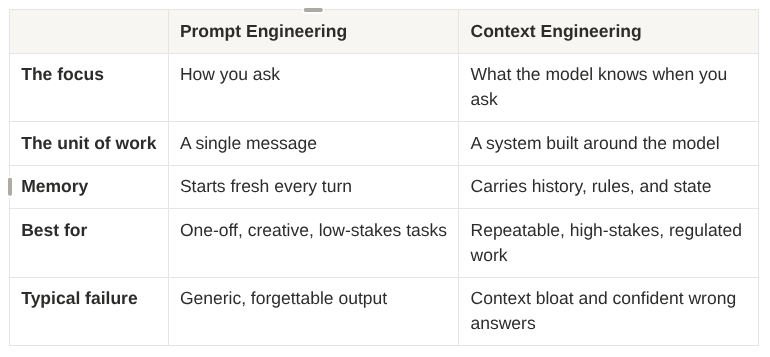
The reason this matters now is capability. Models have gotten good enough that the wording matters less and the surrounding information matters more. When the model already knows your world, the prompt can get shorter and the answer gets sharper.
My Takeaway: The job is changing shape under us. The skill that scaled in 2024 was writing the perfect instruction. The skill that scales now is deciding what the model should know before it ever reads one.
Think less like a copywriter polishing a line, more like a showrunner deciding what a character knows when they walk into the scene. The wording is the last five percent. The world is the rest.
Where Context Engineering Pays Off: Real-World Examples
Across the leaders I heard from, one signal came through louder than the rest. Context engineering earns its complexity when the answer depends on the world, not on the phrasing. The clearest way to see it is to watch what changes the moment the model finally gets the full picture.
Start with two fields where the stakes are easy to feel: money and health.
Andrew Gazdecki, Founder and CEO of Acquire.com, runs a leading marketplace for buying and selling software companies. When he’s matching founders to buyers, the wording of the prompt was never the bottleneck. The data was. “Context is key to matching founders with suitable buyers,” he said. Feeding the system actual transaction history and browsing behavior improved match quality, though the payoff took time to arrive.
The same lesson scales up to your bloodwork. Max Marchione, Co-Founder of Superpower, is building a preventive health platform around lab results and wearables, where a single instruction can’t see the whole person. “We realized static prompts missed the big picture with wearables and biomarkers,” he said. “Moving to context engineering took time but made spotting risks much more reliable.” A prompt asks one question. A context layer watches the trend.
Now turn to the work most of us do every day: producing content that has to hit the same mark over and over.
This is where consistency becomes the prize. Gabriel Shaoolian, CEO and Founder of Digital Silk, watched generic AI copy become usable once the model carried the whole business with it, from brand guidelines to audience personas to conversion goals. “That changes the output from generic recommendations to something much closer to a strategic starting point,” he said. “The biggest improvement is consistency because the work reflects the brand and the business objective more reliably.”
Operations tell the same story with more on the line. Orrin Klopper, CEO of Netsurit, a global managed IT provider, described grounding AI in a client’s accumulated knowledge instead of asking it cold. “We shifted the AI from a simple tool to a strategic partner,” he said. The model stopped behaving like a stranger and started behaving like someone who’d read the file.
The further you push toward repeatable, high-stakes work, the more the gains show up as hard numbers.
Runbo Li, Co-Founder and CEO of Magic Hour, a video generation platform, put the whole shift in one image. It’s “the difference between giving someone a single instruction and giving them the full briefing packet before they walk into the room,” he said. After rebuilding around context, his team saw “a 40% reduction in failed generations and dramatically more consistent output.” Same model. Better world.
And at the regulated edge, context stops being an optimization and becomes the entire point. Stephen Ferrell, Chief Product Officer of Valkit.ai, builds AI for pharmaceutical validation, where a wrong answer isn’t a typo. By feeding the model structured regulatory data instead of loose questions, the output moved “from subjective outputs to confident PASS/FAIL verdicts,” he said. Here the truth lives in the standards and the records, outside the model entirely, and context is what makes the answer worth trusting.
My Takeaway: Notice the pattern under the examples. Context engineering pays off precisely where a human expert would refuse to answer without background first.
A good analyst asks for the file. A good clinician asks for the history. A good lawyer asks for the case. When the honest human answer is “it depends, let me see the details,” that is your signal the task belongs to context, not to better wording.
Everything above runs on the same fuel: feeding the system an accurate picture of the world before it acts. You deserve the same picture before you act.
Databox is the context layer for your own decisions. It connects your marketing, sales, finance, and product tools into one dashboard, so the live state of your business is something you can glance at instead of assemble. Think of it as the briefing packet for the person actually running the company.
You can set a goal on any metric and get an alert the moment it drifts, which means you stop discovering problems three weeks late. For a solo operator or a small team, that’s hours back every week and far fewer blind spots.
Build your first dashboard with Databox.
When Context Engineering Backfires
More information isn’t always better information. The most useful warnings in my research came from the leaders most committed to context engineering – because they’re the ones who have seen it fail.
The failure even has a shape. Maria Chatzou Dunford, Lifebit’s CEO, watched it happen when her team enriched a model with too many data types at once, without cleaning them first.
“Garbage in, confident garbage out,” she said. “We learned that context quality gates matter more than context volume.” Rather than getting confused and admitting it, the model synthesized the noise and sounded sure.
Practitioners now have a name for this: context bloat, sometimes called context rot. You stuff the window with everything that might be relevant, and the model loses the thread of what actually is. Latency goes up. Confidence stays high. Accuracy slips out the back.
Orrin Klopper, Netsurit’s CEO, saw it in his own migration work. His team over-fed “legacy on-premise logic into an Azure cloud migration,” and the AI started recommending outdated security protocols with total confidence. The context here was contradictory, and the model could not tell which version of the truth to follow.
Stephen Ferrell, Valkit’s chief product officer, saw the same thing in regulated work. Context “backfired when we dumped raw audit trails without curation,” he said, which triggered false alarms until the team narrowed the inputs to only what each risk level required.
One backfire cuts against everything else here, and it shows up in creative work. Florian Radke, Founder and Strategist of The Brand Algorithm, spends his days getting AI to sound like a brand. He loaded so much brand documentation into one system that the output went flat.
“The brand filter was so tight it strangled creative range,” he said. The model “became rigid and lost the cultural spontaneity we needed for a viral push.” He had built a perfect cage.
This is the worldbuilding trap every writer knows. Pile on enough backstory and rules and the character stops being able to surprise you. The world becomes a wall.
Roland Parker, Founder and CEO of Impress Computers, a managed IT firm serving manufacturers, construction firms, and engineering teams – traced most failures to one missing step. Teams feed “mixed documents into a workflow without defining source priority,” he said, “which raises the risk of bad answers and slows review down.”
His fix is the one every serious practitioner repeats: keep a human in the loop and “treat AI as acceleration, not authority.”
My Takeaway: Context bloat is going to be the next big AI literacy problem, the way an overstuffed inbox or a tab graveyard already is. The reflex to add one more document is the same reflex that degrades the output.
The skill to build now is subtraction: a habit of asking what the model can safely forget. In the next few years, the leaders who manage AI well will be known less for what they feed it and more for what they hold back.
When Prompt Engineering Is Still the Better Choice
Is prompt engineering dead? No. The headlines saying so are selling a course.
What’s true is narrower and more useful: prompt engineering is now a tool with a clear job, not the whole toolbox.
The leaders agreed on where a sharp prompt still wins. The task is small, the stakes are low, and you already hold all the context in your head.
Florian Radke, The Brand Algorithm’s founder, lives in the bloat problem – which makes him the strongest voice for keeping prompts lean in creative work. A tight prompt, he said, “gives the model room to surprise you.” When surprise is the point, a heavy context layer is a liability.
Andrew Gazdecki, Acquire’s CEO, keeps it simple for the routine stuff. “For ordinary batch jobs I still use simple prompts,” he said. He saves the full context setup for the matching problem, where better matches turn into closed deals.
Max Marchione, Superpower’s co-founder, drew the same line by speed, noting that “for quick data points, prompts are still faster.” Building a pipeline around a question you will ask once is its own kind of waste.
Even Maria Chatzou Dunford, Lifebit’s CEO, whose work demands context, defends the sharp prompt for clean, narrow tasks. “When the task is narrow and the output is verifiable, a sharp prompt beats a complex context pipeline every time,” she said.
Then there is the confident minority. A small group said plainly that prompt engineering still does everything their work needs, so they’ve stayed with it on purpose. They tried loading more context, found it made debugging harder, and went back to clear, simple instructions.
Matching the tool to the task is its own kind of expertise. Not every job needs a world built around it. Some jobs just need a good line.
My Takeaway: The future belongs to fluency in both disciplines, plus the judgment to switch between them fast. The expensive mistake is using the wrong tool with conviction: architecting a retrieval pipeline for a one-line job, or firing a bare prompt at a problem where the truth lives outside the model.
Treat prompt engineering and context engineering as two tools, not two opposing camps you have to choose between. The leaders who win move between them by instinct, reaching for whichever one the task in front of them actually needs.
By the Numbers: What 100+ Leaders Showed
When you read more than 100 accounts of the same shift, the patterns get louder than any single experience.
More than 40 of these leaders drew the same dividing line: prompt engineering is how you ask, context engineering is what the model knows. The framing has converged. That alone tells you the discipline is maturing from buzzword into shared vocabulary.
Nearly 40% described a specific moment when more context made the output worse. Context bloat ranks as the dominant failure mode for teams doing this seriously.
Close to 30% said a sharp prompt still wins for one-off, creative, or low-stakes work. The “prompt engineering is dead” story doesn’t survive contact with people actually shipping.
Under 10% said they hadn’t moved past prompt engineering at all. A minority, but a clear-eyed one, and worth more than the hype cycle gives it credit for.
My Takeaway: When a vocabulary converges this fast across genomics, IT, marketing, and health, it usually means a category is forming, with roles and tools and budgets to follow.
The sharper tell is the failure data. A field only starts naming its failure modes once enough people have hit them. Context bloat getting a name is the clearest sign this is past the hype stage and into the plumbing stage.
How to Choose Between Prompt and Context Engineering
You don’t need a framework with a clever acronym. You need a fast read on the task in front of you. Here’s the decision these leaders kept making, distilled into four calls.
Reach for a prompt when the task is a one-off, the stakes are low, and you already hold the context. Drafting an email, reformatting text, brainstorming headlines, a quick summary. Speed beats depth.
Reach for context engineering when the task repeats, the stakes are high, or the truth lives outside the model. Weekly reports, support agents, anything regulated, anything that has to sound like your brand every time. Consistency beats cleverness.
Watch for context bloat the moment your output turns generic, hesitant, or oddly confident about the wrong thing. The fix is almost always subtraction.
Keep a human in the loop for anything that carries consequences. Every serious practitioner here treats AI as acceleration, not as the final word.
The thread tying these together is judgment about scope and risk, which is a more durable skill than any single prompt trick.
The Signal: watch your system prompts. When you find yourself adding a new “if this, then that” exception to the same prompt every week, take note. That steady pile-up means the task has gotten too complex for a prompt to hold – and those rules belong in a context layer, stored as data the system can look up instead of a long, fragile block of instructions that breaks every time you touch it.
Final Thoughts
The job title is already shifting. “Prompt engineer” is giving way to something closer to “context architect,” a person who designs the information environment an AI works inside rather than the sentences it reads. Expect that role to keep climbing in value as more work moves from chat windows into agents that act on your systems.
But the deeper change is in how we think about these tools. We spent years treating the AI model like a vending machine, feeding it the right phrase to get the right snack. The leaders furthest ahead treat it like a new hire instead – someone whose output depends entirely on the briefing, the access, and the rules you give them on day one.
Asimov was silently making this argument seventy years ago. He spent far less ink on what his robots said than on the world he built around them, because he understood that the world was what made them hold together. Strip away the fiction and that is the job now landing on the rest of us. We have all become worldbuilders for our machines, whether the world is a novel or a retrieval pipeline.
The prompt was always the easy part. The work, now, is building the world the machine wakes up in.
☕ Support the Newsletter
Writing this newsletter requires a lot of caffeine. If you feel like donating, you can buy me a coffee here.
Find your next read at my bookshop while supporting local bookstores.
Interested in sponsoring this newsletter? Learn more.
This article contains affiliate links.
Related Reading
Has AI at Work Freed Up Your Time, or Just Created Different Work?
The New Founder’s Guide to Building Business Software in the AI Era
The New Rules for Building Business Software That Lasts